How to Stop Autopilot Rumination (Before It Runs Your Day)
Aug 26, 2026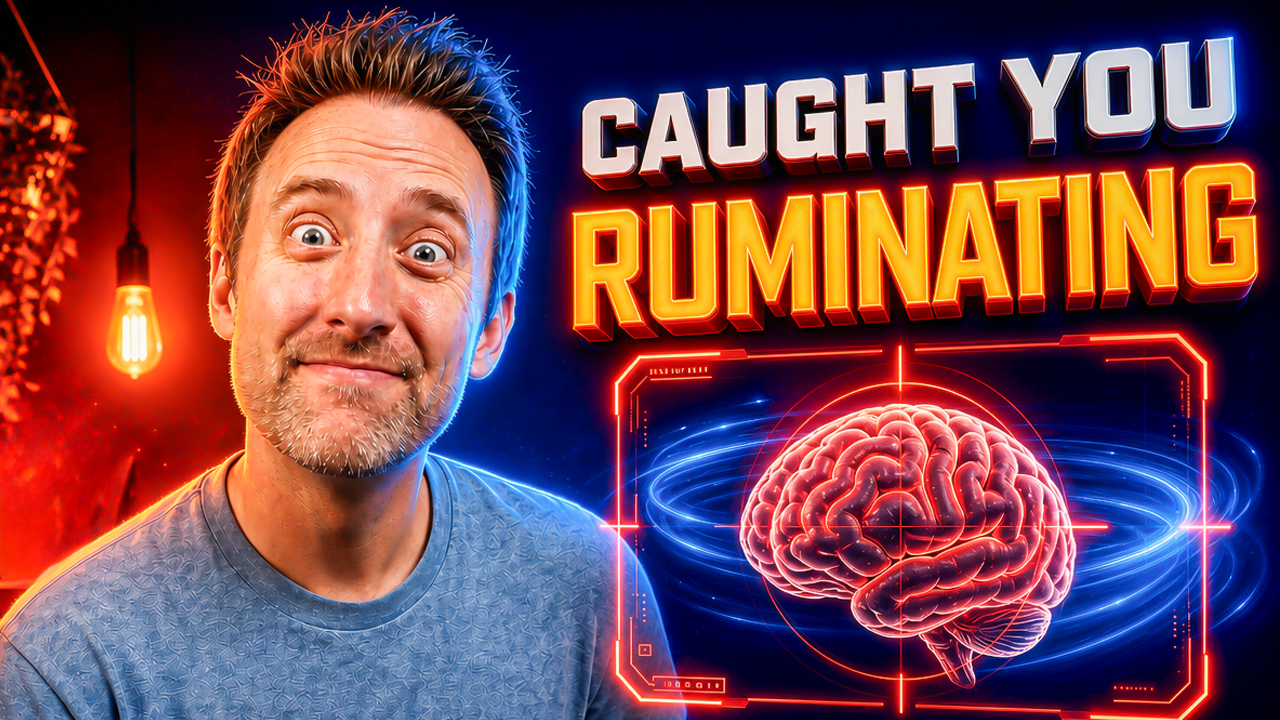
At some point today, you were deep in a thought spiral and you didn't even notice it happening. In the car. In the shower. Staring at your phone. And your brain just went somewhere else, replaying something, worrying about the future, running the same loop it's been running for weeks with no resolution.
You didn't choose that. It just happened.
That's autopilot rumination. And the fact that it's automatic is exactly what makes it so hard to stop. You can't fight something you don't even know is happening.
WHAT IT IS
Rumination Feels Like Thinking. It Isn't.
Rumination feels productive. Like you're working through something. But you're actually just going in circles, looping through the same problems with no resolution. And there's anxiety attached to it because the anxiety won't go away until you reach certainty about whatever the fear is.
I didn't offend that person. I'm not a bad person. I'm not getting sick.
The more you do it, the more automatic it becomes. Your brain runs the loop in the background without you deciding to think about it. It's a bit like getting into a new hobby and suddenly seeing it everywhere — ads, social feeds, dreams. Your brain decided this matters. With rumination, your brain made the same decision. And now it just keeps looping, because it never gets the resolution it's looking for.
The brain interprets rumination as: you must really care about this. I'll keep bringing it up. Even when you try to push it away, you're confirming it matters — which makes it come back more.
Step 1: Track It
The first move is awareness. Over the next few days, notice when you're mid-spiral. Not to judge it — not to say "this is bad, I can't believe I'm doing this" — just to notice the pattern.
Things worth tracking:
- ✓ What time of day is it?
- ✓ What am I thinking about?
- ✓ What resolution do I want from this thing?
- ✓ Where am I? In the car, in bed, on my phone?
- ✓ Am I tired, hungry, stressed?
For me, it's almost always right before bed. Phone goes down and my brain goes: hey, it's time. Here we go. Or driving. Nothing else to focus on. I've basically invited it in without meaning to.
Rumination follows a pattern. Once you know when and where it tends to show up, you can get ahead of it instead of being ambushed by it.
ONCE YOU CATCH IT
Step 2: Don't Fight It — Go With It
The instinct is to push the thought away. But fighting it confirms to your brain that this matters — which makes it come back harder.
Instead: don't fight it, don't figure it out, don't label it as good or bad. Just respond to it with maybe maybe not — because it's almost always an open-ended fear with no clear answer.
- ✓ "Will I be prepared for this presentation?" Maybe, maybe not.
- ✓ "What if I'm sick while I'm there?" Maybe I will, maybe I won't.
- ✓ "What if I'm a bad person?" Maybe, maybe not. Not figuring this out right now.
Give the same answer every time. Eventually the brain starts to realize: this person isn't going to engage with me on this. And it moves on. That's actually the point.
For OCD-related rumination specifically, the response is the same: "Not my thing. Cool. Not doing this. Awesome. You're welcome to be here." Allow the thought. Don't engage with it. Don't resolve it.
The "Worry Time" Advice Is Wrong
You've probably heard the advice to schedule a dedicated worry time — set aside 10 minutes a day and that's the only time you can think about the worry. I hear that advice everywhere.
We don't do that. Purposely making yourself go think about the thing on a schedule is still engaging with it. It's not treating the pattern — it's just moving it to a different time slot.
What we do instead is ERP. The thing that keeps triggering the rumination — go face it. Is there something you can see, touch, write, engage with? Go toward it. Respond differently. Let your brain freak out. "Sweet. That's what I wanted. Let me respond totally differently to it and act like I don't care."
GETTING AHEAD OF IT
Invite It In Before It Shows Up
Once you know when the rumination tends to happen, you can get ahead of it. If it always shows up when you're about to eat dinner, walk into dinner open. "Thoughts want to come? You're welcome."
When you invite something in, sometimes it doesn't actually want to be there. The brain loses interest when there's nothing to fight against.
Some people find it helpful to write down the thought and the response side by side: the thought on the left, "maybe, maybe not" on the right. It creates a little distance and makes the pattern visible.
The Real Plan
Track it. Catch the pattern. When it shows up, don't fight it and don't engage with it. Use maybe maybe not and keep going. Get ahead of it by knowing when it tends to arrive. And do ERP on whatever is feeding the rumination in the first place.
The Master Your OCD course has worksheets specifically for tracking OCD and anxiety symptoms, including rumination patterns. You can try it free. Your OCD Will Hate This Book also walks through the same tracking process with QR-linked worksheets.

Nathan Peterson, LCSW — Licensed therapist specializing in OCD, anxiety, and related conditions. Nathan has helped thousands of people through evidence-based treatment and education.
LCSW Licensed Therapist | 10,000+ Course Students | 24M+ YouTube Views | Penguin Random House Author
 |
Stop the loop for goodMaster Your OCD includes symptom tracking worksheets, ERP training for rumination, and a complete step-by-step system for every OCD theme.
|
Author