Saying "Sure" to OCD Changed Everything
Apr 22, 2026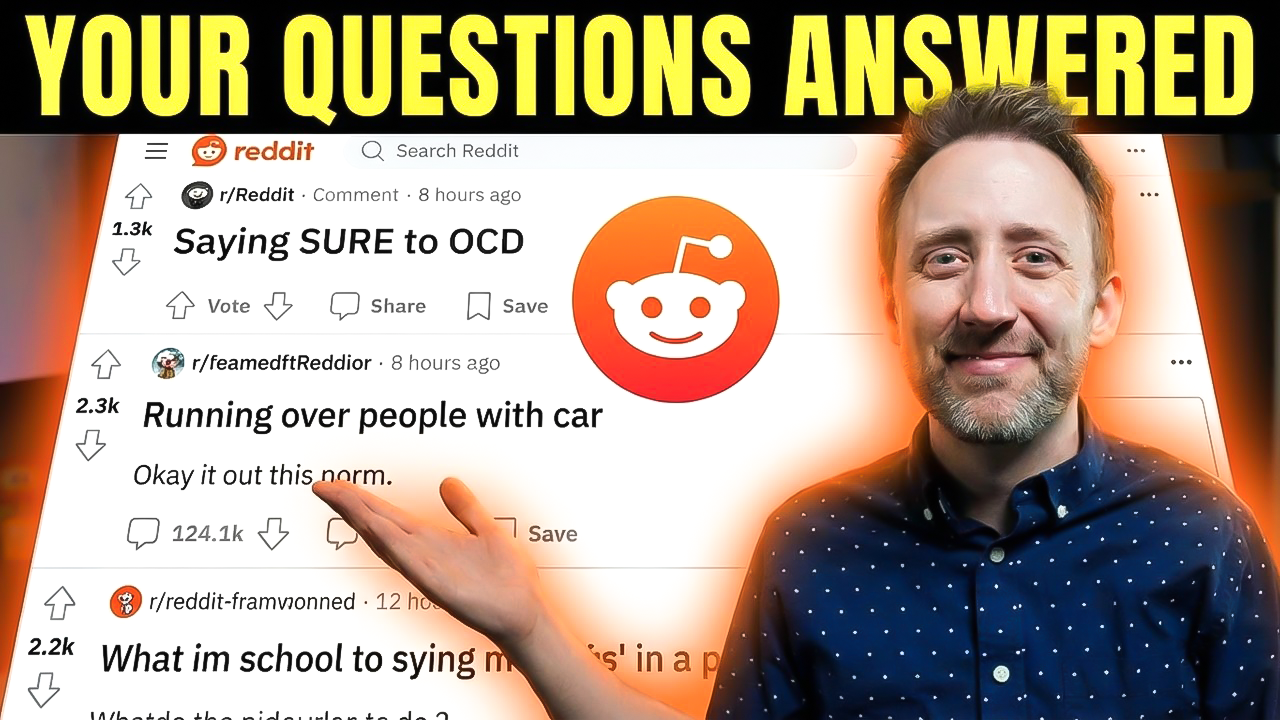
Saying "Sure" to OCD Changed Everything: Reddit Q&A Part 3
Saying "Sure" to OCD Changed Everything: Reddit Q&A Part 3
OCD therapist answers real Reddit questions about why "maybe, maybe not" works better than fighting, how to tell your gut from OCD, false memory spirals, and more.
Question #1: "OCD Got Better Once I Started Saying 'Sure'"
"OCD got better once I started saying 'sure' to whatever it suggested. Every time OCD would throw something catastrophic at me—'You're going to lose your job,' 'You're going to be homeless,' 'You're going to get into a horrible accident'—I used to fight back with 'No, I won't. That's highly unlikely.' But then OCD would just come back: 'But it could happen.' And drag me into a spiral of researching and imagining worst-case scenarios. So instead, I just started saying 'Sure, maybe.' And it worked better than anything I've tried."
Why I Love This
You know why this works?
Because our normal reaction—the one we've learned our whole life—is to say:
- "No, that's not true."
- "It's not possible."
- "That's not going to happen."
But it doesn't stick around.
Because you're right—anything IS possible.
The OCD-Specific Response: "Maybe, Maybe Not"
So our responses for OCD become:
"Maybe, maybe not."
"You're going to get into a horrible accident."
→ "Maybe I will. Maybe I won't."
How do you know for sure that you won't?
You don't. Which is why the brain sticks with it.
So: Maybe, maybe not.
Or Go the Agreeing Route
"Sure, man. Awesome. Maybe it will happen. Great. Hope so."
Have you tried "hope so" before?
That one seems even scarier because it feels like you're putting bad juju out in the world.
But it also shows that words are words.
They mean nothing unless we give them power.
What "Sure, Maybe" Really Means
"Sure, maybe" is a good way to say:
"I really don't care. If there's a problem, there's going to be a problem and I'll solve it when the time comes."
Question #2: Obsessing Over Chinese New Year Hair Washing
"People are saying that if you wash your hair on Chinese New Year (February 17th), you will have bad luck. I have never heard that in my entire life. It is causing me to spiral because I need to wash my hair today. I haven't washed it in almost a week. It seems superstitious and silly, but it's making me spiral."
The Answer
Isn't that interesting?
Someone can come up with something so random and we all go along with it.
But that only has power because we gave it power.
Someone down the line did.
Why Saying "That's Ridiculous" Doesn't Work
I could sit here and say:
"That's ridiculous. That's just a made-up thing. It means nothing."
It's kind of like saying today's donut day, tomorrow's pizza day, tomorrow's national whatever.
These are made-up things just because.
But it doesn't make someone stop spiraling.
Because the brain's like: "But what if, though? What if?"
What to Do Instead
We go back to: "I don't know. What do I want to do?"
"I want to wash my hair. I'm going to wash my hair."
"I'm going to risk that I am cursed or it's bad luck or whatever."
Don't Check for Bad Luck All Day
Here's what people do:
They wash their hair, then spend the rest of the day checking if they're having bad luck.
They trip. Something happens. They hit their head on the cabinet.
And they think: "It's because of this!"
But how do you know that thing wouldn't have happened anyway?
You don't know.
Which is why we continue to use uncertainty in all cases.
"I don't know. I want to wash my hair, so I'm going to wash my hair."
That ends up being the exposure you're going to do.
Because the compulsion would say: "I'm going to avoid it just in case."
Question #3: How Do I Tell My Gut From OCD?
"Does anyone else struggle with separating your gut from OCD? It's pretty easy to identify OCD and my gut feeling mostly, but every time I want to tell myself it's just an intrusive thought, my OCD fires back: 'It's actually just maybe it's your gut.'"
The Problem With "Trust Your Gut"
It's such an interesting thing.
You're supposed to trust your gut. I see people say it all the time.
But what does that actually mean?
Our gut can say: "Okay, well, I have this weird feeling and I have this thought and I'm feeling some anxiety about it, so it must be true."
That means trusting our gut.
But what if you have OCD and you're getting that moment 50 times a day?
How are you supposed to know?
The Test
Here's what I know:
Looking at the clouds four times and blinking—is that something you want to do?
Did you do that before you had OCD?
If you imagine yourself in 10 years, is that something you want to keep doing?
If not, we're willing to risk it.
"I need to look at the clouds and blink four times or I'll die."
→ "I'm not even going to look at the clouds at all and I'm going to say: Maybe I'll die. Maybe I won't. We'll see."
When Do You Actually Trust Your Gut?
When it's not terrorizing you. When it's an every-once-in-a-while thing.
If your gut is telling you the same thing over and over and over, day after day after day—it's not your gut.
It's OCD.
And sometimes we have gut feelings and we miss it. That's life.
We can go back and say "Oh, I knew it."
But we didn't—because if we knew it, we would have done the thing our gut told us to do.
We're all still living with uncertainty. And that is okay.
Question #4: Is OCD Learned or Genetic?
"Is OCD learned? Genetic? A combination? I remember early in life having OCD and it just seemed awful quick to learn."
The Answer
OCD tends to be genetic.
When we think "genetic," we think: "Okay, well, my mom doesn't have it. My dad doesn't have it. My grandpa, my great grandpa..."
Doesn't mean they specifically actually have to have OCD.
They can have:
- Hair pulling
- Skin picking
- Tics and Tourette's
- Body dysmorphic disorder
- Just an anxiety disorder in general
And some of these older generations didn't talk about this stuff.
But "Learned" Is Interesting
I do hear a lot of parents say:
"My kid is watching me do this behavior over and over and I'm so scared they're going to start doing it."
But we're all just so different.
We all make our own decisions and we get to do what we want to do.
Even though I could watch my dad exercise my whole life, doesn't mean I'm going to do that.
I can make my own decisions.
When Does OCD Appear?
If my child has OCD, it might be genetic.
But it often appears:
- During puberty
- After a traumatic moment
- Completely randomly—"I heard something at school about amoebas and all of a sudden my brain's like 'Ah!'"
You're already prone to have it and it pops out: "Now's my chance."
Question #5: Confused About What's Real
"Does anyone else feel confused—not knowing what is reality, what is real, constantly questioning perceptions of reality? What do I do to find clarity? I'm losing my mind."
This Might Be Depersonalization or Derealization
Usually what happens is:
Someone feels like "I'm having all these thoughts and they are not who I am as a person and it just feels so real but that's not me. I'm over here."
"What do I do with it? I almost feel separated from the moment."
What to Do
We try NOT to figure out your perceptions of reality.
"Is this real? Is this not real?"
→ "I don't know. Maybe it is, maybe it isn't."
The more we try to figure out reality and understand it all, the more you actually stay stuck in that cycle.
Practice This
Every time your brain says: "Is this a real moment?"
→ "I don't know. Maybe, maybe not. Hope not. That's sweet. Cool. I love this feeling that I'm having that I don't know my reality right now."
We want to change our reaction to something like that.
Question #6: Worried About Running Over People With My Car
"How common is it that people with OCD struggle with worrying about hitting people or pedestrians with their car when driving? This has been something I've been struggling with a lot lately."
Reddit Can Be Helpful... Or a Compulsion
Reddit is cool because you can share your experience with others.
Comments are probably: "Yeah, I've got it too. I've got it too."
Yes, it's normal.
It can help you feel like: "Yeah, other people got this. I'm not crazy."
But it can also turn into a compulsion.
"If other people have this and I have to keep telling every single experience that I have and they say it's fine, then I feel better."
Always think before you post: Do I just want to feel heard, or do I just want to get this anxiety to go away?
The Treatment
When it comes to hit-and-run OCD:
"What do I want to do? I've got to drive to work."
Stop the protective measures:
- Stop checking mirrors over and over
- Stop driving extra slow
- Stop avoiding crosswalks or school zones
When your brain says: "That bump—was that a person?"
→ "Maybe it was. Maybe it wasn't. I don't know."
"But are you sure?"
→ "I don't know. Maybe it is. Maybe it isn't."
"But if you did it, you're going to go to jail."
→ "Maybe I will. Maybe I won't."
Change your reaction. Stop the compulsion of avoiding or protecting.
Question #7: Can You Talk About Non-OCD Things in Therapy?
"Can you talk to your ERP therapist about non-OCD-related things?"
The Answer
No, only OCD.
Just kidding!
I actually have a lot of people I talk to where it started out with OCD.
We do a lot of OCD treatment and they've gotten to a point where:
"Now I'm living life. I still have OCD, but now I need to talk about other things:"
- Getting a job
- Working
- Relationships
- Getting my own apartment
We can talk about life experiences.
Because guess what? Life's not all about OCD.
Most therapists will allow you to do that because: What is affecting you the most right now?
Actually, if someone's talking about other things than their OCD most of the time, it means it's not really bothering them that much—which is a good thing.
Or they're trying to avoid it so they don't have to do exposure therapy. You have to be careful with that too.
Question #8: How Do I Deal With False Memory OCD?
"How does anyone deal with false memory OCD? It's literally been taking over my life in all aspects. And it seems like it could be anything."
What False Memory OCD Is
False memory is all about coming up with an idea of something that happened in the past—could even be five minutes ago.
It can take a real moment and say:
"Well, you must have done something bad in that real moment."
"I know you just took the elevator on the way to work and there was someone in there with you, but what if you did something inappropriate? What if you talked to them and it made them uncomfortable? I don't remember what happened."
It's creating memories that didn't exist.
Where People Get Stuck
They try to keep replaying the situation to make sure they didn't do something wrong or inappropriate.
And that keeps them stuck because they're absolutely not sure.
The Treatment
"Okay, I took the elevator. Did I do something inappropriate when that person was there?"
→ "I don't know. Maybe I did, maybe I didn't."
That becomes the new answer.
"I'm really worried about that elevator. It triggers me."
→ Let me keep doing that. Practice it. Take that elevator.
Hope people are in there and my brain says: "Yep, you're going to do something. You're going to have a bad memory about this."
→ "Yeah, maybe I will, maybe I won't."
Exposure Scripts
Sometimes people create scripts for this:
I write out the scenario exactly what happened.
Maybe I write out the catastrophes too.
And I'm responding differently to the story.
So I'm not replaying it in my head. I outline it and respond differently.
Question #9: ERP Is Working!
"Started ERP a couple months ago and recently I've noticed less intrusive thoughts and have been able to block some compulsions. I'm so proud of myself."
That's It!
That is the thing I've been telling you the whole time.
Our brain does not want to do it.
"This is not the treatment you should do," OCD says.
It works.
Just put all your arms down. (How many arms do you have?)
Put everything down and say:
"I'm just doing it, man. I don't care. I'm not going to fight it. Let me go do the exposures because it actually works."
The Bottom Line
Stop fighting OCD.
Start saying "sure, maybe" or "maybe, maybe not."
Stop mentally reviewing false memories.
Stop checking for bad luck all day.
Stop trying to figure out if your gut is OCD.
Just live your life. Do the exposures. Change your reaction.
ERP works. Trust the process.
Nathan Peterson, LCSW
OCD and Anxiety Specialist
Creator of "OCD and Anxiety" YouTube Channel
Developer of Master Your OCD Online Course
Author